If you’ve added sensors, smart controllers, or connected equipment to your plant floor in the last few years, you already know the operational benefits: real-time monitoring, predictive maintenance, better data for production decisions. What’s less obvious is that each one of those devices is also a potential entry point for attackers.
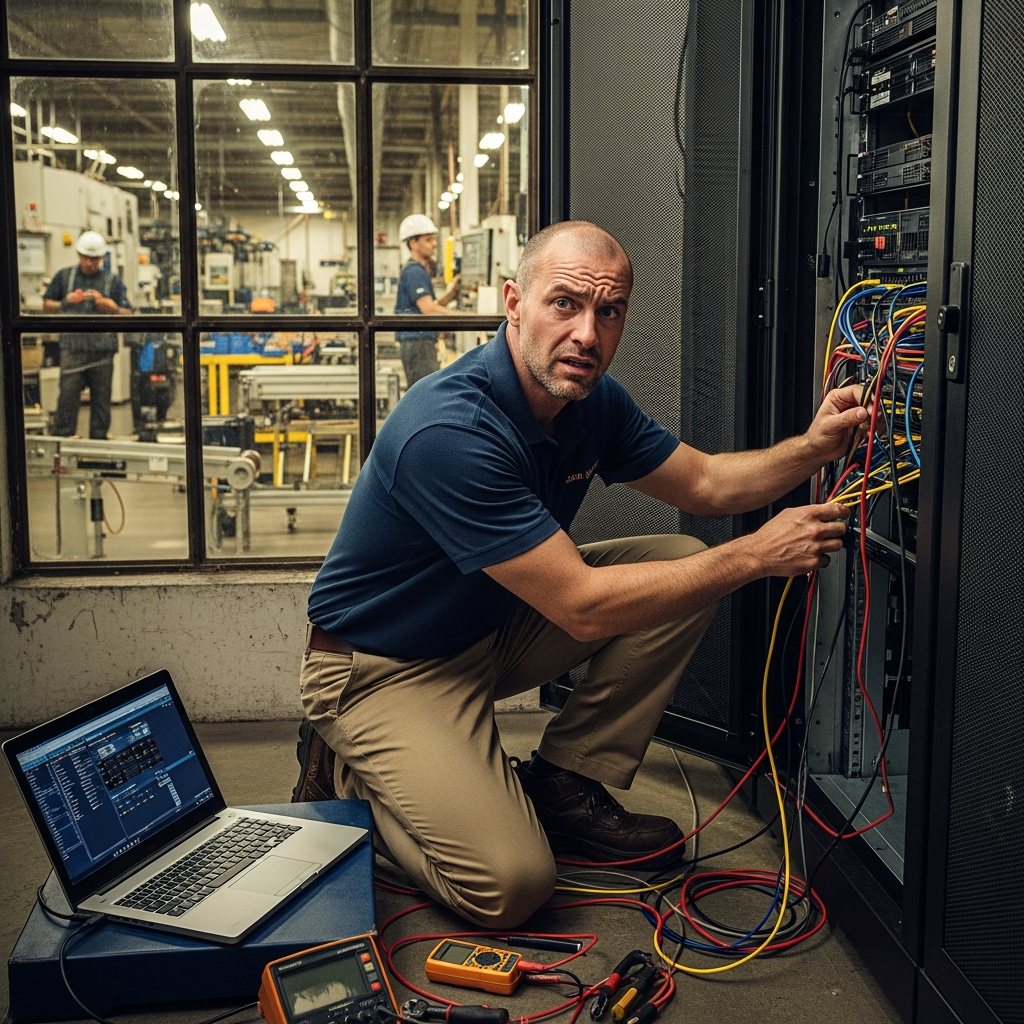
Industrial IoT (IIoT) security is one of the most pressing challenges facing manufacturers in Northwest Arkansas right now. Unlike traditional IT assets — laptops, servers, phones — plant floor devices were often designed for reliability and uptime, not security. Many run outdated firmware, use default credentials, and communicate on unencrypted protocols built decades before cybersecurity was a serious concern. As those devices connect to business networks (and through them, to the internet), the exposure compounds fast.
This post lays out a practical, risk-based framework for securing IIoT devices without turning your IT budget inside out or grinding production to a halt.
Why IIoT Is Different From Regular IT Security
Security teams are comfortable protecting laptops and servers. You push patches, enforce MFA, monitor endpoints with an EDR agent. IIoT is harder for a few reasons:
- You can’t just install an agent. Most PLCs, HMIs, sensors, and industrial gateways don’t support third-party security software.
- Downtime is expensive. Rebooting a server for a patch is routine. Taking a production line offline to update firmware is a scheduled event that requires approvals and planning.
- Protocols weren’t designed for security. Modbus, PROFINET, DNP3, and similar OT protocols pre-date modern security concepts. They don’t authenticate traffic or encrypt communications.
- Vendor lifecycles are long. A PLC installed in 2010 may still be running critical processes today — with software that hasn’t seen a security update in years, if ever.
This doesn’t mean IIoT security is hopeless. It means you need a different approach: one focused on isolation, visibility, and risk prioritization rather than trying to treat every device like a managed endpoint.
Step 1 — Know What You Have
You cannot protect what you don’t know about. IIoT asset discovery is often the first surprise for manufacturers who haven’t audited their OT environment recently.
A proper asset inventory should capture:
- Device type, make, and model
- Firmware or software version
- Network address and communication protocols
- What the device connects to (other OT assets, IT systems, cloud platforms)
- Who owns or manages it (internal team, OEM, systems integrator)
- Whether it’s accessible remotely
Passive network monitoring tools — Claroty, Dragos, Nozomi, or Armis are commonly used in manufacturing — can discover devices without generating traffic that might disrupt sensitive industrial systems. For smaller operations, even a manual walkthrough with a spreadsheet is better than nothing.
The output is a living asset register. It’s not glamorous work, but every security control you build later depends on it.
Step 2 — Segment Your Network (Seriously)
If your plant floor devices share a flat network with your business systems, a compromise on any one device could move laterally to everything else — including file servers, email, ERP, and backups. This is how ransomware operators get from a forgotten HVAC controller to your entire operation.
Network segmentation creates boundaries that limit what a compromised device can reach. For manufacturers, this typically means:
- A dedicated OT/ICS network for plant floor devices, physically or logically separated from the IT network
- A DMZ (demilitarized zone) layer for any systems that need to communicate between OT and IT — historians, MES platforms, etc.
- Firewall rules that enforce a default-deny posture: traffic between zones is blocked unless explicitly permitted
- VLANs to further subdivide the OT environment by function or risk level (CNC machines in one segment, environmental sensors in another)
| Network Zone | What Lives Here | Connectivity |
|---|---|---|
| OT/ICS | PLCs, HMIs, sensors, controllers | No direct internet; limited IT access via DMZ |
| DMZ | Historians, MES, data bridges | Controlled access from both OT and IT |
| IT | Business PCs, servers, email, ERP | Standard IT security controls |
| Internet | External services, cloud platforms | Through firewall with strict egress rules |
Implementing this in a brownfield environment (existing plant, existing devices) is never zero-effort, but it’s one of the highest-impact controls you can put in place.
Step 3 — Prioritize Patches and Firmware Updates
You probably can’t patch everything immediately — and you shouldn’t try. The goal is a risk-based patch program that focuses effort where exposure is highest.
Start by scoring each device category against two factors:
- Exploitability — Is there a known vulnerability? Is it remotely exploitable? Is the device internet-facing?
- Impact — What happens if this device is compromised or goes offline? Does it run safety-critical processes?
Devices with high exploitability and high impact get patched first, on an accelerated schedule. Devices with low impact that aren’t reachable from outside the OT segment can wait for the next scheduled maintenance window.
For devices that can’t be patched at all — old PLCs with no available firmware updates — compensating controls become the answer: network isolation, monitoring for anomalous traffic, and plans for what to do if those devices are affected.
Coordinate with your OEMs and systems integrators. Many of them issue firmware updates that address security vulnerabilities. If your vendor isn’t communicating security updates proactively, that’s worth a conversation.
Step 4 — Change Default Credentials Everywhere
This one sounds obvious. It isn’t, because it’s tedious and because many industrial devices make it genuinely difficult to change passwords. But default credentials remain one of the most common vectors attackers use to gain initial access to OT environments.
Go through your asset inventory and document the authentication state for each device:
- Is the default credential still in use?
- Does the device support individual user accounts, or is it shared access?
- Is the management interface accessible from outside the OT network?
Where credentials can be changed, change them — and store them in a password manager or secrets vault, not a spreadsheet on someone’s desktop. Where devices are too old to support modern authentication, that’s a factor in your network segmentation decisions.
Remote access deserves special attention. Any IIoT device or OEM system accessible via VPN, RDP, or a vendor portal should require MFA. If a vendor needs remote access to your equipment, they should be using a secure, monitored jump host — not a standing connection that’s always on.
Step 5 — Monitor for Anomalies
Patching and segmentation reduce your attack surface. Monitoring is how you catch threats that get through anyway.
In OT environments, “baseline and deviate” monitoring is more practical than signature-based detection. Most industrial networks are remarkably stable — the same devices, communicating in the same patterns, day after day. Anything that deviates from that baseline (a new device appearing, unusual communication between systems that don’t normally talk, a PLC attempting to reach the internet) is worth investigating.
Purpose-built OT monitoring platforms like Dragos, Claroty, or Nozomi can passively capture and analyze industrial network traffic without touching the devices themselves. For smaller operations, a simpler approach — centralized logging, network flow data to a SIEM, and alerts on key anomalies — can still provide meaningful visibility at a lower cost.
Tie your OT monitoring into your broader incident response process. If something unusual is detected on the plant floor, there should be a clear path to who gets notified, how the device gets isolated, and what happens to production in the meantime.
Applying This in Northwest Arkansas
NWA manufacturers operate across a wide range of environments — from small job shops with a handful of CNCs to larger facilities running complex automated lines. The right approach to IIoT security scales accordingly.
What doesn’t scale is doing nothing. Regulators, insurers, and customers are all paying more attention to OT security posture. Defense contractors in the region face CMMC requirements that extend to OT systems. Insurance carriers are asking more pointed questions about network segmentation and device inventories before they’ll underwrite cyber coverage.
The good news: you don’t have to solve everything at once. A risk-based approach means starting where your exposure is highest — internet-facing devices, default credentials, flat networks — and building from there.
Where to Start This Week
If you’re not sure where your IIoT security stands, a few immediate steps can give you traction:
- Run a quick inventory — walk the plant floor and document every connected device you can find. Cross-reference against your firewall’s known devices.
- Check your segmentation — can plant floor devices reach your business network or the internet directly? If so, that’s the first thing to address.
- Audit remote access — who can access your OT systems remotely? Are those connections MFA-protected and logged?
- Find your riskiest devices — identify internet-facing or unpatched devices running critical processes and put them at the top of your remediation list.
IIoT security doesn’t require a massive budget or a complete overhaul of your network. It requires a clear-eyed assessment of where you’re exposed and a systematic plan to reduce that exposure over time.
Ready to get a handle on your plant floor security posture? Get in touch.