For most manufacturers, the scariest cyber scenario isn’t a ransom note on a workstation — it’s the production line going dark. When a hacker can move freely from your accounting system to your programmable logic controllers (PLCs), that nightmare becomes very real. Network segmentation is the architectural fix that keeps those two worlds separated, and it’s one of the highest-impact security investments a manufacturer can make.
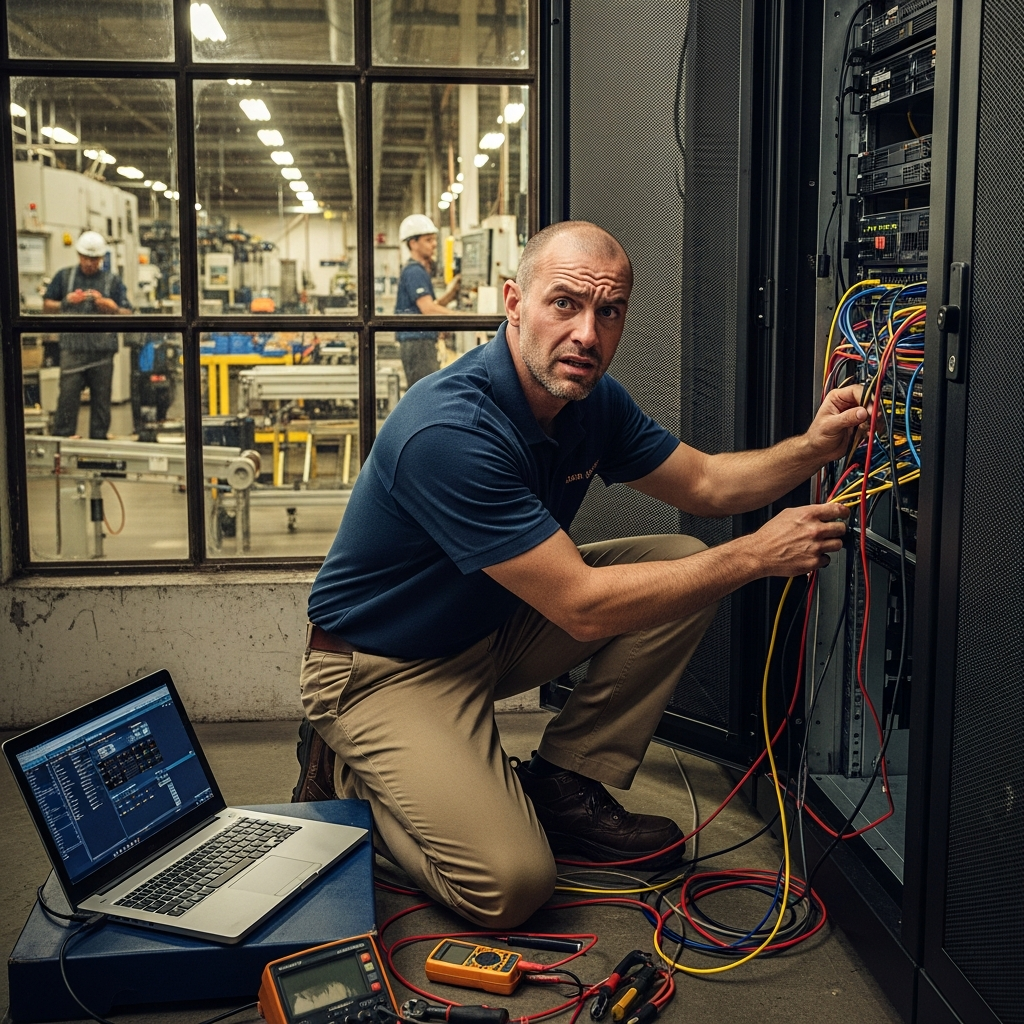
This guide walks through what network segmentation means in a manufacturing context, why the plant floor carries unique risk, and how Northwest Arkansas manufacturers can approach implementation without a six-month shutdown.
Why the Plant Floor Is Different
In a typical office, if a computer gets infected with ransomware, your IT team can isolate it, wipe it, and restore from backup. The business limps along. Annoying, expensive — but recoverable.
On a plant floor, the stakes are different:
- OT (Operational Technology) systems — PLCs, SCADA servers, HMIs — run 24/7 and often can’t be patched quickly or rebooted without stopping production.
- Many OT devices run legacy operating systems (Windows XP, Windows 7) that manufacturers stopped supporting years ago.
- Production uptime may be contractually required. An unplanned stoppage isn’t just lost revenue — it can trigger penalties with customers.
- Some equipment vendors void warranties or support agreements if unauthorized software is installed, making even antivirus a gray area.
Without network segmentation, a phishing email clicked by someone in accounting can become a stepping stone to your SCADA server. That’s the attack path manufacturers need to close.
What Network Segmentation Actually Does
Segmentation divides your network into distinct zones. Traffic between zones is controlled by firewalls, switches, or dedicated security appliances — not left to roam freely. Think of it like the bulkheads in a ship: if water breaches one compartment, the others stay dry.
For manufacturers, the standard model draws a hard boundary between:
- IT network — corporate systems, email, ERP, file servers, internet access
- OT network — PLCs, SCADA, historians, HMIs, industrial controllers
- DMZ (Demilitarized Zone) — a controlled buffer zone where systems that need to talk to both sides (like a data historian that feeds into your ERP) live under strict rules
This isn’t about making the plant floor unreachable. Engineers still need to access HMIs remotely. Your ERP still needs production data from historians. Segmentation controls how that communication happens — through defined, monitored pathways — rather than leaving it wide open.
The Risks of a Flat Network
Many small and mid-sized manufacturers still run what’s called a flat network: one big subnet where everything can talk to everything. It’s simple to set up and often how a facility grew organically over the years.
The problem is flat networks are a cybersecurity nightmare:
| Flat Network | Segmented Network |
|---|---|
| Any device can reach any other device | Traffic between zones requires explicit permission |
| Malware spreads laterally without restriction | Breach is contained to the zone where it started |
| One compromised login = access to everything | Compromised credentials limited by zone scope |
| Hard to detect abnormal traffic patterns | Anomalous cross-zone traffic triggers alerts |
| Single firewall at the perimeter | Multiple control points throughout the network |
| Audit logs hard to attribute to specific systems | Clear visibility into which zone traffic originated |
A flat network that worked fine in 2010 is a liability today. The threat landscape has changed dramatically — manufacturing is now one of the most-targeted industries by ransomware groups precisely because uptime pressure creates leverage for attackers.
How Segmentation Is Implemented
1. Map What You Have
Before you can segment, you need to know what’s on your network. In manufacturing environments, this is harder than it sounds — facilities often have equipment added over decades with minimal documentation. A proper asset discovery exercise identifies every device: IP address, OS version, what it communicates with, and what it does.
2. Define Your Zones
Based on criticality and communication patterns, group systems into logical zones. Common zones in a manufacturing environment include:
- Corporate IT zone — workstations, printers, phones, email servers
- Production OT zone — PLCs, motor drives, safety systems, HMIs
- Engineering zone — programming workstations for OT systems, often needing access to both IT and OT
- Historian/Integration zone (DMZ) — data collection servers that bridge IT and OT
- Guest/Vendor zone — isolated internet access for contractors without touching internal systems
3. Implement Firewall Rules Between Zones
A next-generation firewall (NGFW) between zones enforces which traffic is allowed and which is dropped. Rules should follow the principle of least privilege: only the specific communication that’s needed is permitted.
For example:
- The historian in the DMZ can read data from PLCs in the OT zone on port 102 (S7 protocol) — nothing else inbound.
- Engineering workstations in the engineering zone can reach specific HMI IPs in the OT zone via RDP — but only during business hours, only from authenticated sessions.
- No workstation in the corporate IT zone can directly communicate with any device in the OT zone — period.
4. Monitor Cross-Zone Traffic
Segmentation controls access, but monitoring detects when something unusual tries to cross zone boundaries. Intrusion detection systems (IDS) and security information and event management (SIEM) platforms watch for anomalies — a SCADA server suddenly trying to reach an external IP, for instance, is a major red flag.
5. Secure Remote Access
Remote access to OT systems needs its own secure channel — a jump server or privileged access workstation (PAW) in the engineering zone that logs all sessions. This replaces the common (and dangerous) practice of opening direct RDP or VNC ports to plant floor systems.
Common Mistakes to Avoid
Mistake 1: Segmenting the network but leaving inter-zone rules too permissive. A firewall that allows “any to any” traffic between IT and OT isn’t segmentation — it’s just a speedbump. Rules need to be specific.
Mistake 2: Not accounting for wireless. Guest Wi-Fi networks that share the same VLAN as corporate or OT systems undermine everything. Wireless segmentation matters as much as wired.
Mistake 3: Ignoring vendor access. Many OT vendors require remote access to service equipment. That access needs to land in an isolated zone with monitored jump server access — not a VPN that dumps them onto your corporate network.
Mistake 4: Doing it once and forgetting it. Networks change. New equipment gets added. Rule sets drift. Segmentation needs periodic review — quarterly at minimum — to make sure it still reflects how the facility actually operates.
What This Looks Like for NWA Manufacturers
Northwest Arkansas has a diverse manufacturing base — food processing, aerospace suppliers, packaging, logistics equipment, and consumer goods. Each facility has its own mix of legacy OT equipment and modern IT infrastructure, which means there’s no single template for segmentation.
What works at a food processing plant in Springdale (where hygiene monitoring systems need to feed into ERP for compliance reporting) looks different from an aerospace supplier in Rogers (where ITAR requirements add another layer of network access controls).
The common thread: facilities that have invested in proper network segmentation have significantly shorter incident response times when something does go wrong, because the blast radius of any breach is contained. The question is never if an incident will occur — it’s how much damage it causes when it does.
Getting Started Without Disrupting Production
The biggest concern manufacturers have is downtime. Here’s the practical path:
- Start with asset discovery — passive scanning tools can map your network without touching OT devices.
- Design your zone architecture on paper first, reviewed with your OT vendor and operations team.
- Pilot in a less-critical area — a single production cell or building rather than the whole facility.
- Phase implementation — segment IT from OT first, then refine zones within OT over subsequent months.
- Test communication paths extensively before going live in each area — work with your OT vendor to validate that equipment still communicates as expected after segmentation.
This isn’t a weekend project. A thorough segmentation implementation for a mid-sized manufacturer typically takes three to six months. But each phase incrementally reduces risk — you don’t have to wait until everything is done to start seeing benefit.
The Bottom Line
Network segmentation is the single most effective architectural control a manufacturer can implement to limit the damage of a cyberattack. It doesn’t prevent every incident, but it means a compromised workstation in accounting can’t take down your production line — and that distinction matters enormously when uptime is your business.
Ready to assess where your plant floor network stands? Get in touch.